
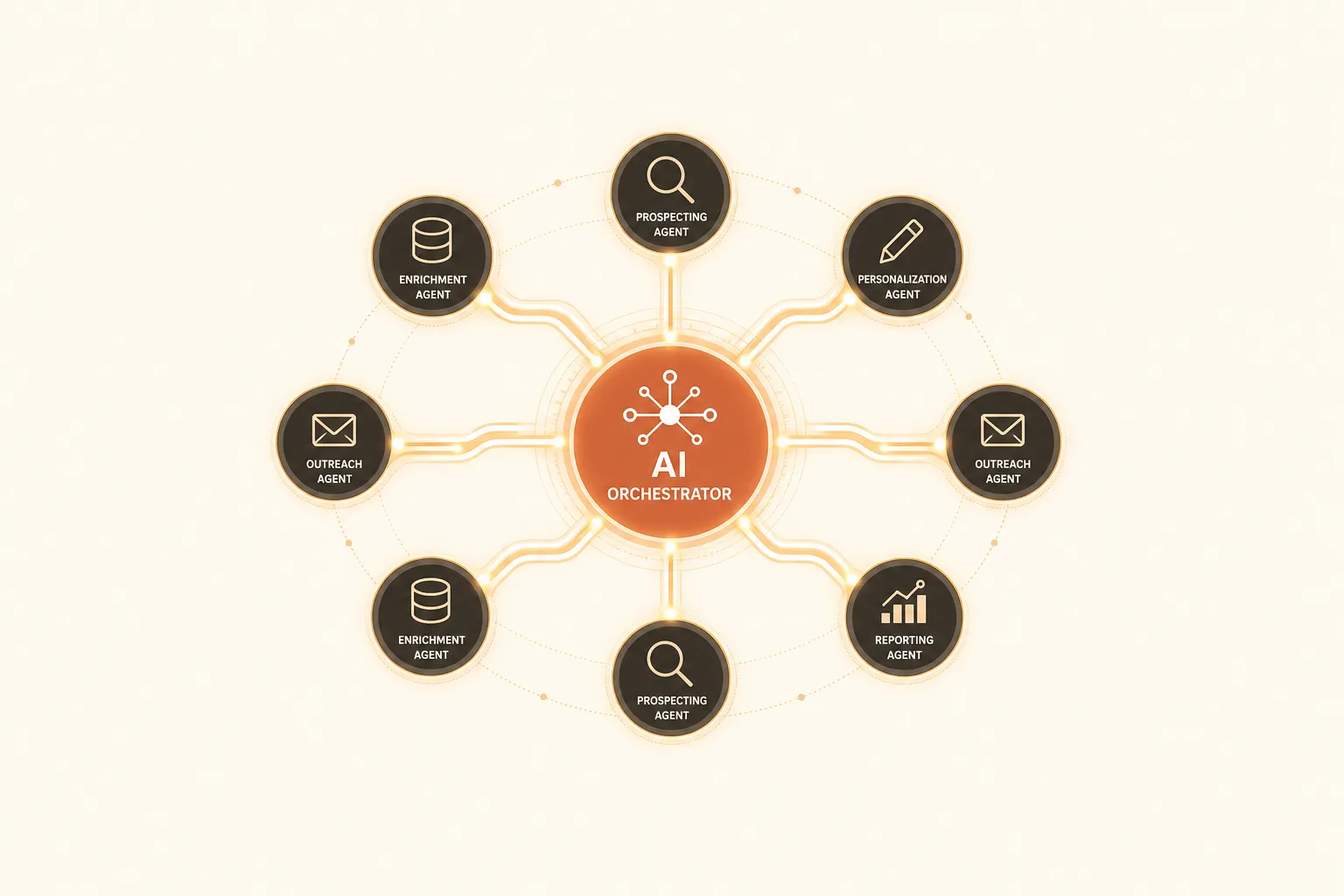
Most teams that adopt AI for sales do it wrong. They plug a single AI assistant into their CRM, ask it to draft emails, and call it automation. That's not a system — that's autocomplete. A genuine multi-agent AI system for sales and marketing is something different: a coordinated network of specialized agents that research, enrich, personalize, send, follow up, and sync data — running in parallel, handing off outputs between themselves, operating unattended. Teams that build this replace what used to require five to eight headcount with a single GTM engineer and an API bill.
What Is a Multi-Agent AI System and How Is It Different From a Single Agent?
A multi-agent AI system is a network of two or more AI agents, each with a specific role, model, memory, and tool set, that collaborate to complete complex multi-step tasks. Unlike a single agent limited to one context window and sequential execution, a multi-agent system runs specialized agents in parallel, passes structured outputs between them as inputs, and handles long-horizon workflows that exceed what any single model context window can hold.
A single agent is fine for discrete tasks: summarize this document, draft this email, classify this response. The moment a task requires more than one domain of reasoning — find prospects, research them, write personalized emails, send them, log the results — a single agent collapses. Context windows fill. Errors compound.
Multi-agent systems solve this by specialization. A prospecting agent focuses only on finding accounts that match your ICP. An enrichment agent focuses only on augmenting those accounts with firmographic data. Each agent is narrow, fast, and accurate within its domain.
Stanford and Google DeepMind research on multi-agent frameworks found that role-specialized systems outperform single large models on complex, multi-step tasks by 15–40% on accuracy benchmarks — while reducing per-task token consumption by splitting context windows across agents.
| Dimension | Single Agent | Multi-Agent System |
|---|---|---|
| Context window | One shared window | Each agent has its own |
| Parallelism | Sequential only | Agents run in parallel |
| Specialization | Generalist | Each agent optimized per domain |
| Fault isolation | One failure = total failure | Subagent failure retried independently |
| Scalability | Context-limited | Scales horizontally |
| Task complexity ceiling | Low-to-medium | Long-horizon, multi-domain |
Key Takeaway: A multi-agent AI system runs specialized agents in parallel, each owning one function and passing structured output to the next. That's what gives you parallelism, fault isolation, and the ability to handle tasks that span multiple domains — none of which a single agent can deliver reliably at scale.
What Agents Make Up a Complete Sales and Marketing Multi-Agent Stack?
A complete sales and marketing multi-agent stack typically runs eight specialized agents: Prospecting, Enrichment, Research, Personalization, Outreach, Reply Classification, CRM Sync, and Reporting. Each agent owns one function, uses its own tools, and passes structured output to the next agent. The result is a fully autonomous GTM pipeline — from ICP match to booked meeting — with no human intervention required at any stage.
Prospecting Agent
Queries LinkedIn Sales Navigator, Apollo.io, or ZoomInfo to identify target companies and contacts matching your ICP. Output: qualified lead list with contact metadata.
Enrichment Agent
Augments each raw lead record with firmographics, technographics, funding data, and intent signals. Tools: Clay, Clearbit, BuiltWith, Bombora, Crunchbase. Output: enriched records ready for research.
Research Agent
Conducts deep account research for high-priority prospects — recent news, LinkedIn activity, job board signals, product launches. Output: a structured "account brief" per target account consumed by the personalization agent.
Personalization / Copywriting Agent
Takes the account brief and writes personalized outreach — email, LinkedIn message, or call script — tailored to the specific person, company, and context. Output: draft messages flagged for send or human review.
Outreach / Sequencing Agent
Sends emails, schedules follow-ups, and manages multi-touch sequences. Tools: Smartlead, Instantly.ai, Outreach.io, HubSpot Sequences. Output: sequences launched, replies routed to the classification agent.
Reply Classification Agent
Reads inbound replies and classifies them: interested, not interested, objection type, referral, out-of-office. Output: routing decision — book meeting, pause sequence, escalate to human, or fire an objection-handling response.
CRM Sync Agent
Writes all enriched data, sequence status, reply classifications, and booked meetings back to your CRM via MCP. Output: clean, up-to-date CRM records with full activity history.
Reporting Agent
Pulls campaign performance, pipeline data, and reply rates. Generates weekly briefings and surfaces anomalies. Output: structured Slack message or email delivered before Monday standup.
Key Takeaway: An eight-agent sales and marketing stack covers every step from ICP identification to CRM sync with no human required between stages. Each agent is narrow, tool-equipped, and passes structured JSON to the next. That's what makes the system reliable at 10,000 contacts per month — not just 100.
How Do You Architect a Multi-Agent System Using the Orchestrator Pattern?
The orchestrator/subagent pattern is the dominant architecture for production multi-agent sales systems. An orchestrator agent receives the top-level goal, breaks it into subtasks, delegates each subtask to a specialized subagent, aggregates outputs, and passes results to the next stage. Subagents execute one function each and return structured JSON. This separation makes the system debuggable, testable, and scalable independently.
The pipeline structure looks like this:
[Trigger: new lead list / scheduled cron]
              |
     [Orchestrator Agent]
    /          |          \
[Prospecting] [Enrichment] [Research]
   Agent        Agent        Agent
    \          |          /
   [Personalization Agent]
              |
      [Outreach Agent]
              |
  [Reply Classification Agent]
              |
      [CRM Sync Agent]
              |
    [Reporting Agent → Slack]
The orchestrator has four responsibilities:
- Task decomposition — breaks "find and contact 100 ICP-fit companies this week" into discrete subtasks per agent
- Agent routing — selects which subagent handles which subtask based on input type
- Error handling — retries failed subagent calls, escalates to human on repeated failure
- Output aggregation — collects structured outputs from parallel subagents and assembles a unified result
Agents communicate through three handoff mechanisms:
- Direct function call — orchestrator calls subagent as a tool, passes JSON, receives JSON. Synchronous. Best for linear pipelines.
- Message queue (async) — agents publish to Redis or SQS; next agent subscribes. Best for high-volume workflows where steps don't need to wait.
- Shared state store — all agents read/write to a shared state object (LangGraph's StateGraph or a Postgres table). Best for conditional workflows where mid-task decisions change the path.
For high-stakes actions — sending emails to enterprise accounts, updating deal values in your CRM — add a human-in-the-loop approval node. The orchestrator pauses, sends output to Slack for review, and waits for approval. This is the "policy": "confirmation" setting in Claude Managed Agents — the same pattern applies in any framework.
Key Takeaway: The orchestrator/subagent pattern gives you a single control point for task decomposition, routing, and error handling — while each subagent executes one function independently. Human-in-the-loop approval gates are the right guardrail for any action that sends external communications or modifies live CRM data.
What Tools and Frameworks Do B2B Teams Use to Build Multi-Agent Systems?
B2B teams building multi-agent sales and marketing systems use one of five primary frameworks: Claude Agent SDK, LangGraph, CrewAI, AutoGen, or n8n. For production Anthropic-powered systems, the Claude Agent SDK is the strongest choice — native MCP support, parallel tool calls, and direct integration with Claude Managed Agents. LangGraph wins on complex conditional flows. CrewAI gets you to a working prototype fastest. n8n is the right call for non-engineering teams.
| Framework | Language | Best For | MCP Support |
|---|---|---|---|
| Claude Agent SDK | Python / TS | Production Anthropic-powered agents | ✓ Native |
| LangGraph | Python | Complex conditional state machines | Via tool wrappers |
| CrewAI | Python | Role-based crews, fastest prototype | Via tool wrappers |
| AutoGen | Python | Research, collaborative agent chat | Via tool wrappers |
| n8n | Visual + JS | Non-engineering teams, low-code | Via HTTP nodes |
Claude Agent SDK — the native framework for Claude-powered agents. Parallel tool calls, MCP servers, and direct deployment to Claude Managed Agents. If you're building on Anthropic models, this is the correct starting point. Prototypes move directly to production without rewrites.
LangGraph — graph-based framework where agents are nodes and edges define conditional handoffs. Supports stateful workflows, human-in-the-loop checkpoints, and streaming. The strongest framework when pipeline logic branches based on mid-task decisions — for example, routing high-intent replies differently from low-intent ones.
CrewAI — models agents as a "crew" with defined roles, goals, and backstories. A Sales Crew of Prospector, Researcher, and Copywriter is a natural fit. Over 100,000 developers using the framework as of mid-2025. Fastest path to a working multi-agent prototype — a three-agent crew can be running in under a day.
n8n — visual workflow builder with native AI Agent nodes in v1.x. Chain agent nodes with HTTP Request nodes for enrichment APIs and Email Send nodes for outreach. Self-hostable — important for companies with data residency requirements. The right choice for marketing or RevOps teams who want to own the pipeline without writing Python.
For teams building on Claude who want this architected and deployed without the framework overhead, Agentyug's AI agent development service builds production multi-agent systems using the Claude Agent SDK and Managed Agents, including custom MCP server setup for your specific tool stack.
Key Takeaway: Claude Agent SDK for production Anthropic systems. LangGraph for complex conditional logic. CrewAI for the fastest prototype. n8n for non-engineering teams. The wrong framework choice costs weeks — pick based on your team's technical profile and your pipeline's complexity, not popularity.
How Do You Build Your First Multi-Agent Sales System Step by Step?
Building a multi-agent sales system follows five steps: pick one high-value workflow, map the agents and tool dependencies, build and test each agent in isolation, wire the orchestrator to chain them, then add monitoring and a human-in-the-loop approval gate. Start with a two-agent minimum — research and personalization — before expanding. The discipline of isolation testing is what separates systems that scale from ones that break at 1,000 contacts.
Step 1: Pick One Workflow
Don't build everything at once. Start with the workflow where manual effort is highest and output is most measurable. For most B2B teams, that's prospect research + personalized first-line generation. One enriched, personalized contact record is the unit of output — everything else is overhead until this works.
Step 2: Map Agents and Tools
For a research + personalization two-agent system, you need:
- Research Agent — web search (Serper/Tavily), LinkedIn (Proxycurl), Crunchbase API
- Personalization Agent — Claude Sonnet, email template library, A/B variant prompts
Define the JSON input schema for each agent and the JSON output schema they return. Structured handoffs between agents are non-negotiable — free-form text breaks at scale.
Step 3: Build and Test Each Agent in Isolation
import anthropic

client = anthropic.Anthropic()

def run_research_agent(company_domain: str, contact_name: str) -> dict:
    result = client.messages.create(
        model="claude-sonnet-4-6",
        max_tokens=1024,
        tools=[web_search_tool, linkedin_tool],
        system="""You are a B2B research specialist. Given a company domain
and contact name, return a structured JSON account brief with:
recent_news (list), job_signals (list), tech_stack (list),
pain_points (list), personalization_angle (string).""",
        messages=[{
            "role": "user",
            "content": f"Research {contact_name} at {company_domain}. Return structured JSON."
        }]
    )
    return result  # parse JSON from result content
Test each agent with 10–20 real inputs before wiring together. Bugs caught in isolation are 10x faster to fix than bugs caught in a chained pipeline.
Step 4: Wire the Orchestrator
import asyncio

async def run_outreach_pipeline(lead_list: list[dict]) -> list[dict]:
    # Run research agent in parallel across all leads
    research_tasks = [
        run_research_agent(lead["domain"], lead["name"])
        for lead in lead_list
    ]
    account_briefs = await asyncio.gather(*research_tasks)

    # Personalization runs sequentially, consuming research output
    results = []
    for lead, brief in zip(lead_list, account_briefs):
        email_draft = run_personalization_agent(brief, lead)
        results.append({**lead, "email_draft": email_draft})
    return results
Parallel execution on the research step cuts processing time for a 100-lead list from minutes to seconds. Chain personalization after — it needs the research output.
Step 5: Add Monitoring and Human-in-the-Loop
Before automating sends, route every email draft to a Slack channel or Airtable view for human approval. Track approval rate per batch. After two consecutive weeks above 90% approval, you have data to justify switching to automated operation. Below 90% means your personalization agent or research agent has a quality issue — fix in isolation, not in production.
Key Takeaway: Start with two agents. Test in isolation before chaining. Use human-in-the-loop for two weeks before automating sends. The slowdown at each of these checkpoints saves weeks of debugging production failures later.
What Results Are Real Companies Getting From Multi-Agent AI in Sales and Marketing?
Companies running production multi-agent systems in B2B sales and marketing report 10–30x throughput increases, 20–40x cost reduction on research tasks, and measurable pipeline velocity improvements. Clay users reduce per-contact research time from 20–30 minutes to under 60 seconds. Artisan AI's multi-agent SDR platform processes 1,000+ personalized sequences per day — versus a human SDR's 50–100 daily activities. McKinsey data shows companies deploying AI in sales ops report a 3–15% revenue uplift and 10–40% cost reduction.
Salesforce (Agentforce)
Salesforce deployed multi-agent Agentforce for its own sales team — handling lead routing, meeting prep briefs, and follow-up drafting. Result: 30%+ reduction in pre-meeting research time per rep. In the first 30 days post-launch, Agentforce handled over 1 million autonomous agent tasks across the Salesforce ecosystem.
HubSpot (Breeze AI Agents)
HubSpot's multi-agent Breeze platform chains four specialized agents: Prospecting, Content, Social, and Customer. Early beta users reported a 3x increase in qualified leads from automated prospecting sequences.
Artisan AI (Ava)
Multi-agent architecture — prospecting, enrichment, personalization, outreach, follow-up. Processes 1,000+ sequences per day versus a human SDR average of 50–100 daily activities. Cost: $500–$2,000/month versus $60,000–$100,000/year for a fully loaded human SDR. That's a 20–40x cost reduction on the volume outreach function.
Clay.com
Clay's waterfall enrichment chains 10+ data providers in sequence — a multi-agent enrichment pipeline in everything but name. Over 100,000 active GTM users as of early 2025 report reducing per-contact research time from 20–30 minutes to under 60 seconds. A 20–30x speed improvement on the enrichment function alone.
The macro data confirms the trend. LinkedIn's State of Sales 2024 found that 76% of sales reps who exceeded quota used AI tools at least once per week — versus 48% of reps who missed quota. Salesforce's State of Sales report found AI adoption among sales teams grew from 24% in 2023 to 45% in 2024.
That's the structural shift behind why companies are replacing SDR teams with GTM engineers. One engineer running an eight-agent stack doesn't just match a five-person SDR team — it outproduces them on volume while generating cleaner data and better personalization. The productivity gap is not incremental — it's architectural.
If you want to map out the right multi-agent architecture for your specific team, tool stack, and pipeline volume, book a consultation with Akansh. One session identifies which workflows to automate first and what the build timeline looks like before you write a single line of code.
Key Takeaway: Production multi-agent systems in B2B sales deliver 10–30x throughput and 20–40x cost reduction on research tasks. The results are not projections — they're documented across Salesforce, HubSpot, Clay, and Artisan. The teams building these systems now are setting the efficiency baseline their competitors will have to match within 12–18 months.
Frequently Asked Questions
What is a multi-agent AI system in sales and marketing?
A multi-agent AI system is a network of specialized AI agents — each with a distinct role, tools, and model — that collaborate to execute complex, multi-step workflows. In sales and marketing, this typically means agents for prospecting, enrichment, research, personalization, outreach, reply handling, and CRM sync, all running in coordination under an orchestrator agent.
What's the difference between a multi-agent system and a single AI agent?
A single agent runs one task at a time in one context window. A multi-agent system runs specialized agents in parallel, each optimized for one function and passing structured outputs to the next. Multi-agent systems are faster, more accurate on complex tasks, and more resilient — a failure in one agent doesn't cascade to others.
What framework should I use to build a multi-agent sales system?
For production Anthropic-powered systems, start with the Claude Agent SDK — native MCP support, parallel tool calls, and direct integration with Claude Managed Agents. For complex conditional pipelines, LangGraph is the strongest option. For rapid prototyping, CrewAI gets you running fastest. For non-engineering teams, n8n is the right low-code choice.
How much does it cost to run a multi-agent sales system?
LLM API costs run approximately $0.01–$0.05 per contact for a full research-and-personalization workflow. At 10,000 contacts per month, that's $100–$500 in model costs. Compare to a fully loaded human SDR at $60,000–$100,000 per year. The cost reduction at volume is 20–40x.
Can I build a multi-agent system without writing code?
Yes. n8n and Relevance AI both support multi-agent workflows with minimal or no code. n8n chains AI Agent nodes with API connectors in a visual builder. Relevance AI provides pre-built sales and marketing agent templates. For complex systems with custom MCP integrations, a developer is needed.
How long does it take to build a production multi-agent sales system?
A two-agent research + personalization prototype takes 1–2 days with the Claude Agent SDK or CrewAI. A full eight-agent stack with MCP integrations to HubSpot, Slack, and Salesforce takes 2–4 weeks. Time to production depends almost entirely on how many custom MCP servers you need to build for your existing tool stack.
Related Reading
- What Are Claude Managed Agents and How Do You Deploy Them for B2B Workflows? — Anthropic's hosted infrastructure for running production agents without managing the runtime
- Why Are Companies Replacing SDR Teams With GTM Engineers? — The economics behind the multi-agent shift in B2B sales
- How Do GTM Engineers Use Claude Code to Build Pipeline on Autopilot? — Agentic CLI workflows that complement multi-agent systems
About the Author
Akansh is the founder of Agentyug and has spent the last 5 years building AI automation systems for marketing agencies and B2B businesses. He's built 500+ workflows, automated lead generation pipelines that achieve 90%+ open rates, and helped teams reclaim 20–40 hours per week. Has deployed multi-agent sales systems using Claude Agent SDK, LangGraph, and CrewAI for B2B teams processing 10,000+ contacts per month. Connect on LinkedIn or view the author profile.
Sources
- Multi-Agent Systems documentation, Anthropic
- Model Context Protocol specification, Anthropic / MCP Community
- LangGraph documentation, LangChain
- AutoGen: Enabling Next-Gen LLM Applications via Multi-Agent Conversation, Microsoft Research / arXiv
- State of AI in Sales 2024, HubSpot
- State of Sales Report, 6th Edition, Salesforce
- The State of Sales Report 2024, LinkedIn
- The economic potential of generative AI, McKinsey Global Institute