
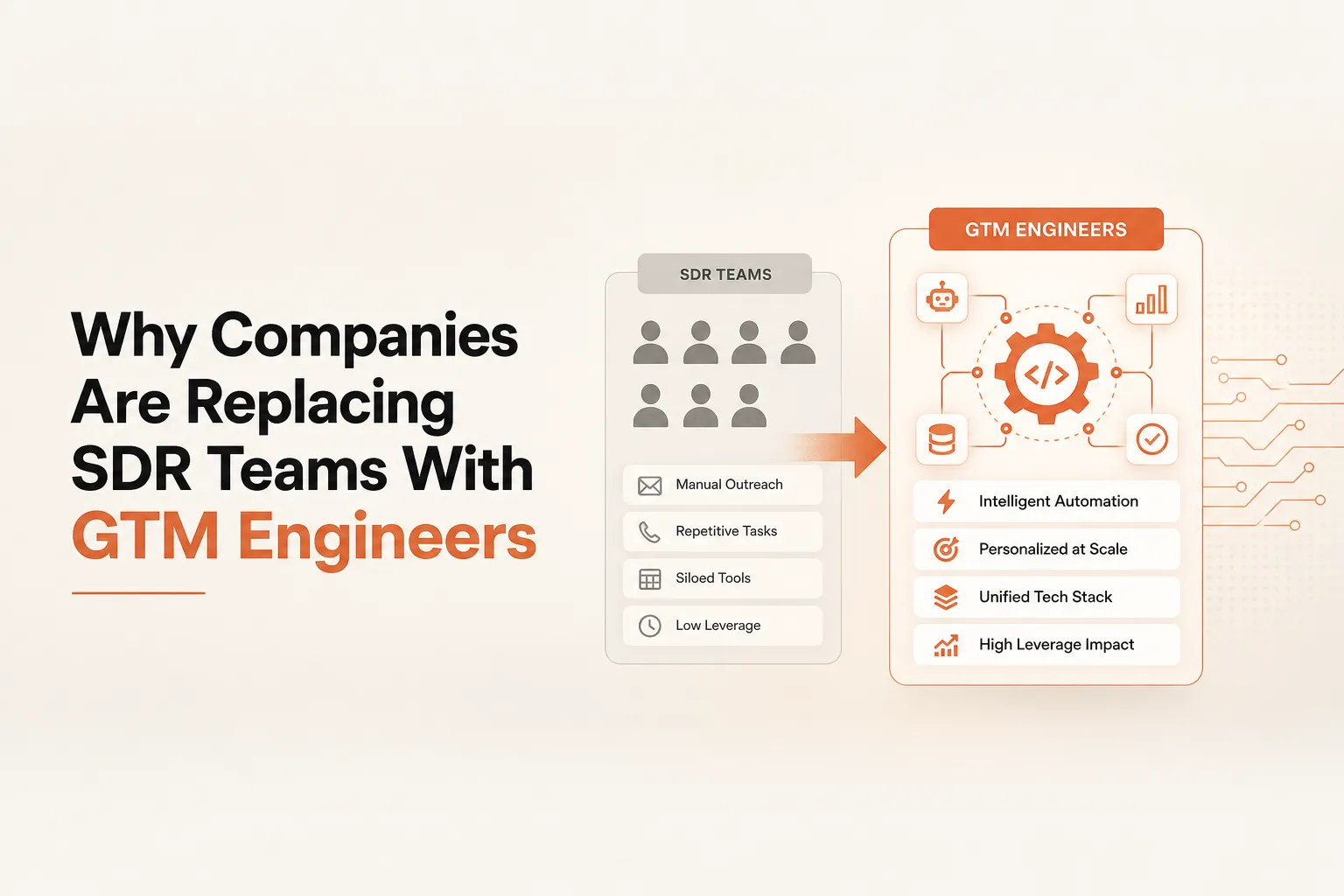
36% of B2B companies cut their SDR and BDR headcount in 2025. That's the highest reduction rate across any sales role — from a survey of over 560 venture-backed companies by Emergence Capital. Cold email reply rates dropped from 6.8% in 2023 to 5.8% in 2024. SDR annual turnover runs between 39 and 60%. The economics of building large SDR teams stopped working. A new job title is filling the gap — and it's not a rebrand.
What Is a GTM Engineer and Why Does This Role Exist?
A GTM (Go-to-Market) engineer is a technical operator who builds the automated systems that generate pipeline — replacing the repetitive, manual work of traditional SDRs. They write the playbook once, build the infrastructure to execute it continuously, and let the system handle prospecting, enrichment, and outreach at scale. One GTM engineer typically replaces 3 to 5 SDRs in terms of output.
The role was coined and popularised by Clay in 2023. It exploded in 2024 and 2025 as AI tools became reliable enough to replace manual SDR tasks. GTM engineer job postings grew 205% year over year in 2025, according to an analysis of 1,000 GTM engineering roles by Bloomberry.
The core insight: most SDR work is repeatable, data-driven, and rule-based. Research a prospect, write a personalised email, send it, follow up. That's a workflow. Workflows can be automated.
The SDR model was built for a world where outreach was scarce and personal. That world is gone. Every inbox is flooded. The only way to stand out is hyper-relevance at the moment of intent — and humans can't move that fast at scale.
Key Takeaway: A GTM engineer doesn't do outbound work manually — they build the system that does it automatically, then measure and improve the system's performance continuously.
What Are the Real Economics Behind Replacing SDRs?
The SDR model is expensive and fragile. The average SDR takes 3 to 6 months to ramp, costs $60,000 to $80,000 in total compensation, and turns over at 39 to 60% per year. One GTM engineer, at a median salary of $127,500, operates automation infrastructure that reaches 800 to 1,500 prospects per day with higher personalisation than a manual SDR team of five — at under half the annual cost.
Run the numbers. A five-person SDR team at $65K fully-loaded each costs $325,000 per year. With a 50% turnover rate, you're replacing 2 to 3 people annually. Add $4,000 to $7,000 per replacement in recruiting costs — that's another $10,000 to $21,000 before you factor in ramp time lost.
One GTM engineer at $127,500, plus $400 to $600/month in tools (Clay, Apollo, Smartlead), costs under $135,000 per year. That system runs 24/7, doesn't quit, and improves as you feed it better data.
According to Emergence Capital's "Beyond Benchmarks" survey of 560+ venture-backed B2B companies (April 2025):
- 36% decreased SDR headcount — the highest reduction across all sales roles
- Only 19% increased SDR headcount — the lowest growth rate among all sales functions
- 44% maintained current SDR team size
The CFO math is not complicated. Three SDRs sending generic emails from a static list, or one systems operator running signal-based outreach that fires only when a prospect shows buying intent — it's not a close call.
Key Takeaway: Five SDRs cost $325,000+/year with high turnover risk. One GTM engineer plus automation tools costs under $135,000/year and scales to thousands of personalised touchpoints daily without adding headcount.
What Does a GTM Engineer Actually Do Differently Than an SDR?
An SDR executes outreach. A GTM engineer builds the infrastructure that executes outreach automatically. The SDR asks: "Who should I email today?" The GTM engineer asks: "How do I build a system that identifies the right prospect at the right moment and sends the right message without human input?" That shift in thinking changes everything about how pipeline gets built.
Here's how the two roles compare in practice:
| Task | SDR | GTM Engineer |
|---|---|---|
| Prospecting | Manual list building | Automated signal detection + enrichment |
| Research | 10–20 min per prospect | Automated via Clay + AI agents |
| Email writing | Template + light personalisation | AI-generated with 9+ signals per contact |
| Follow-up | Manual sequences | Automated multi-step workflows |
| Outreach volume | 40–80 emails/day | 500–1,500 emails/day |
| Response to intent signals | Hours or days | Minutes |
| Measurement | Activity (calls, emails sent) | System performance (CAC, pipeline per dollar) |
The mindset shift is the hardest part. SDRs are task executors. GTM engineers are systems thinkers. They don't ask "How do I write a better email?" They ask "How do I build a system that consistently writes better emails for every prospect, automatically, and improves over time?"
For a full breakdown of what this GTM stack looks like in practice, read what the top GTM strategies for SaaS businesses look like in 2026.
Key Takeaway: The difference isn't effort — it's leverage. A GTM engineer's output is a system. That system works while they sleep, scales without additional headcount, and gets better with every iteration.
What Tools Does a GTM Engineer Use?
A GTM engineer's core stack runs on Clay for data enrichment, Apollo or Prospeo for lead sourcing, n8n or Make for workflow automation, Smartlead or Instantly for email sequencing, and the Claude Agent SDK for research and personalisation. The most-cited tool across 1,000 GTM engineering job postings is Clay — the same platform that coined the GTM engineer title.
Here's how the stack breaks down by layer:
Signal and data layer:
- Apollo.io — prospect sourcing, intent signals, 275M+ contact database
- Prospeo — 98% email accuracy, 7-day data refresh cycle
- Clay — waterfall enrichment across 150+ data providers, Claygent AI research
Automation and orchestration layer:
- n8n — self-hosted workflow automation (appears in 28% of GTM engineer job postings)
- Make — visual automation for complex multi-step workflows
- Zapier — app-to-app data routing for simpler setups
AI and personalisation layer:
- Claude Agent SDK / Anthropic API — custom AI agents for prospect research and message generation
- OpenAI API — email drafting, signal interpretation
Outreach layer:
- Smartlead — multi-inbox management, deliverability controls, agency-grade
- Instantly — simpler setup, $47/month, built-in contact database
CRM and attribution:
- HubSpot (52% of GTM engineer roles require it)
- Salesforce (45% of GTM engineer roles require it)
Python appears in 38% of GTM engineer job postings. SQL appears in another 38%. This is not a zero-code role at the senior end — though many operators work entirely in no-code tools.
For a detailed comparison of each tool's cost, capability, and fit, see the full GTM automation tools breakdown for 2026.
Key Takeaway: Clay is the defining tool of the GTM engineer role — it coined the title and remains the most in-demand skill across job postings. Build fluency there first before adding complexity to the stack.
What Results Can One GTM Engineer Actually Deliver?
One GTM engineer running a full Clay-to-Smartlead pipeline can generate 800 to 1,500 personalised outreach touchpoints per day at a reply rate of 8 to 12%, translating to 15 to 50 qualified meetings per month depending on market size and ICP specificity. Documented client deployments show 30% larger average deals, 75% of demos sourced from signal-based workflows, and 60+ hours per week recovered from manual prospecting.
Real numbers from documented deployments:
- Fyle (expense management SaaS): Shifted to signal-based GTM outreach. 75% of demos now sourced from automated workflows. Email response rates rose to 20–30%, up from sub-5% on cold outreach.
- Drivetrain (financial planning SaaS): 6% reduction in CAC, 3x engagement increase, 60+ hours per week saved on manual SDR work.
- Squadcast (incident management SaaS): 30% larger average deal size, 25% less time spent on prospecting.
At Agentyug, we deployed this model for a B2B SaaS agency client. They replaced a two-person SDR team with a single operator running the full stack. Output went from 40 manual emails per day to 800 enriched, personalised emails per day. Reply rates held above 8%. Meetings booked at roughly one per 120 emails sent. Total stack cost: under $400 per month.
The lever that drives these numbers is signal-based triggering. Instead of cold-prospecting from a static list, the system monitors for job changes, funding announcements, hiring surges, and competitor activity — then fires outreach only when intent is fresh. Fyle's 20 to 30% response rates vs. the industry's sub-6% average is entirely explained by this difference in timing.
If you're building this for a lead generation system from scratch, the signal layer is where most teams underinvest — and where the biggest performance gains are found.
Key Takeaway: A well-built GTM system reaches more prospects per day, with higher personalisation, at a lower cost per meeting booked than a traditional SDR team — and the performance gap widens as the system matures.
Does This Mean SDRs Are Obsolete?
SDRs are not obsolete — but the SDR who only does manual outreach is. The market is splitting into two categories: SDRs who evolve into GTM-fluent operators, and SDRs whose manual tasks get automated away. The 19% of companies still growing SDR headcount are building leaner, higher-skilled teams where each rep is amplified by automation rather than working unaided.
61% of B2B buyers now prefer a fully rep-free buying experience, according to Factors.ai research. That means the discovery and initial research phase — historically SDR territory — is being owned by automated systems.
What GTM engineering cannot replace:
- Complex multi-stakeholder deals requiring active relationship management
- Industries where trust is built over months of interaction
- Senior-level strategic conversations requiring deep situational judgment
- Late-stage negotiation, legal, and commercial complexity
What it has already replaced:
- Cold prospecting from static lists
- Manual follow-up sequences with no personalisation
- First-line qualification and lead routing
- First-touch email outreach at volume
The honest answer: if your SDR's primary job is sending 80 cold emails per day from a list, that job is going. If your SDR manages warm conversations, runs discovery, and closes pipeline the automation generates — that role just became more valuable.
Key Takeaway: The SDR role isn't dead. The manual cold-outreach version of it is. Companies that win are redeploying human capacity toward conversation management and closing, while automation handles prospecting and first-touch outreach.
How Do You Build a GTM Engineer Setup Without Hiring One?
Most small and mid-market teams don't need a $127,500 GTM engineer on day one. They need a GTM-engineered system — built once by a specialist, then operated by an existing team member. The minimum viable GTM stack (Apollo + Clay + Smartlead + AI personalisation) costs $350 to $600 per month in tools and can be live within 3 to 4 weeks.
Here's the build sequence:
- Define your ICP precisely — industry, company size, tech stack, hiring signals, funding stage. Specificity here directly improves enrichment data quality.
- Set up your data pipeline — Apollo for sourcing, Clay for waterfall enrichment across 150+ providers to maximise coverage on emails and direct contacts.
- Add AI personalisation — Claygent or Claude Agent SDK to research each prospect and generate context-specific opening lines based on real signals.
- Build your sending infrastructure — 3 to 5 warmed domains, Smartlead or Instantly managing rotation and deliverability.
- Connect to your CRM — HubSpot or Salesforce to log replies, move pipeline stages, and trigger rep follow-up on positive responses.
- Add signal-based triggers — job change alerts, funding news, competitor activity — so outreach fires when intent is highest.
Before you build the system, make sure you have the strategic foundation right. Read the 5 pillars of GTM strategy — a GTM-engineered outbound system built on a weak strategic foundation generates pipeline from the wrong prospects.
Key Takeaway: You don't need to hire a GTM engineer to run a GTM-engineered system. You need the right stack built correctly once, then operated by someone who understands the levers. The barrier to entry is lower than most teams assume.
Frequently Asked Questions
What is the difference between a GTM engineer and an SDR?
An SDR manually executes outbound tasks — prospecting, emailing, calling, and booking meetings. A GTM engineer builds the automated infrastructure that does those tasks without human input. SDRs are measured on activity (emails sent, calls made). GTM engineers are measured on system performance — pipeline generated per dollar invested, reply rate, and meetings booked per 1,000 contacts.
How much does a GTM engineer earn?
Median GTM engineer salary is $127,500, based on an analysis of 1,000 job postings by Bloomberry. The full range runs $132,000 to $241,000 depending on seniority and company stage. Early-stage startups pay $110K to $140K base with equity; growth-stage and public companies pay $150K to $200K base with smaller equity packages.
Can a small company afford a GTM engineer?
Most small companies don't need a full-time GTM engineer. They need a GTM-engineered system built once by a specialist — an automation agency or consultant — then operated by an existing team member. The minimum viable stack (Apollo + Clay + Smartlead) costs $350 to $600 per month in tools. Build time is typically 3 to 4 weeks.
What skills does a GTM engineer need?
Core skills: Clay for data enrichment, API literacy, AI prompt engineering, workflow automation (n8n, Make, or Zapier), and CRM configuration. Python and SQL each appear in 38% of GTM engineer job postings for higher-complexity roles. The meta-skill is systems thinking — designing workflows rather than executing tasks one at a time.
Will AI replace all SDRs?
Not entirely. GTM engineering replaces the manual, repetitive parts of SDR work — cold prospecting, list building, first-touch outreach, and basic qualification. Human SDRs remain essential for relationship-heavy deals, complex multi-stakeholder sales, and late-stage negotiations. The role is not disappearing — it's being restructured around where human judgment adds irreplaceable value.
Is GTM engineering just another name for marketing automation?
No. Marketing automation (Marketo, HubSpot workflows) manages inbound leads and nurture sequences for people already in the funnel. GTM engineering builds the outbound system that finds and reaches prospects before they're in the funnel — using real-time signals, multi-source enrichment, and AI-personalised outreach. The two are complementary, not interchangeable.
Sources
- The Great SDR Downsizing: 36% of B2B Companies Cut Sales Development Teams in 2025, SaaStr (Emergence Capital Beyond Benchmarks, 560+ companies)
- GTM Engineering Is Replacing SDR Teams, Factors.ai
- I Analyzed 1,000 GTM Engineering Jobs — Here Is What I Learned, Bloomberry
- What Do GTM Engineers Earn in 2026?, Apollo.io
- State of Sales, 6th Edition, Salesforce Research
- 30 AI SDR Statistics That Reveal Why Autonomous Sales Agents Are Reshaping B2B Revenue, 11x.ai