
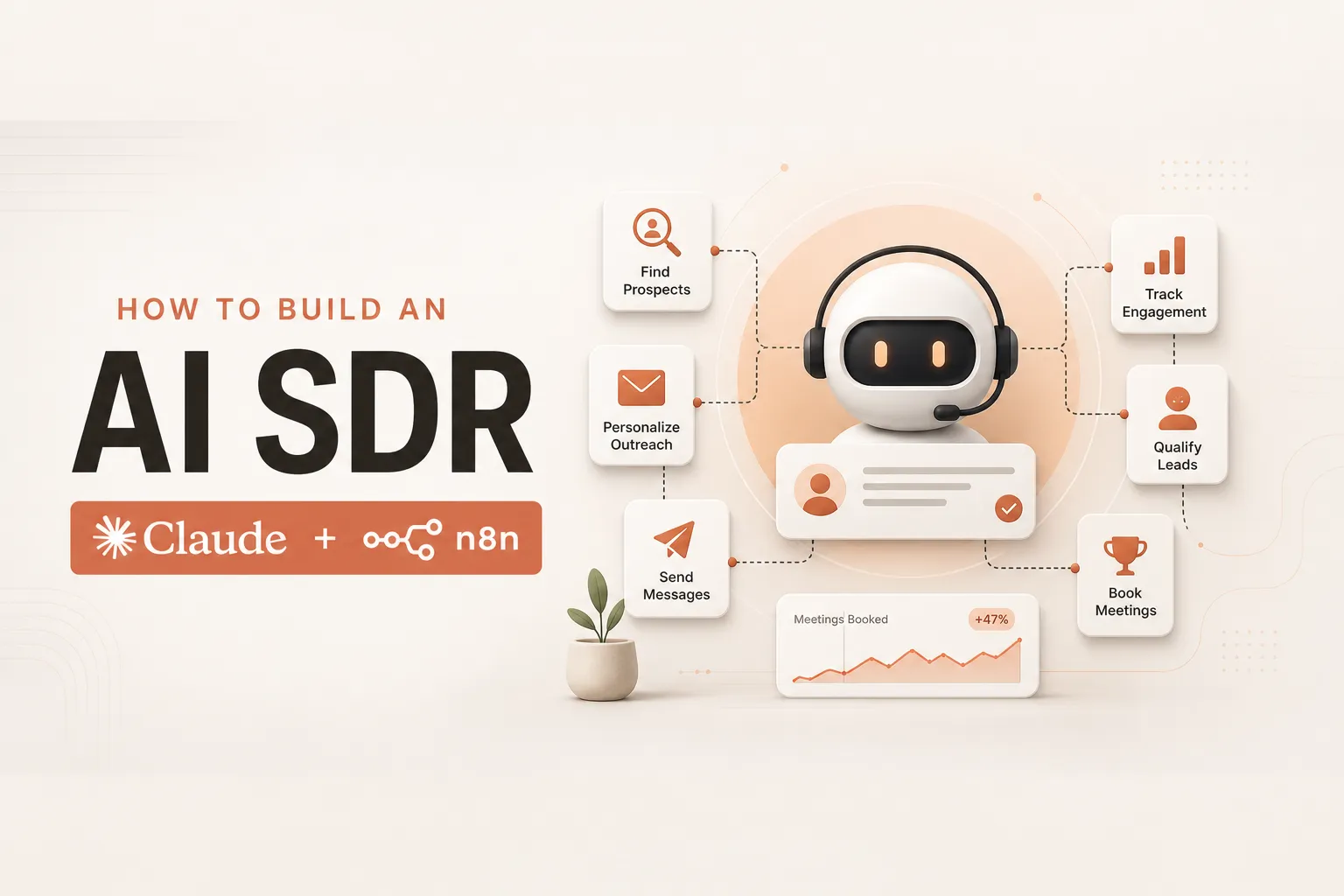
The average rep sends 344 cold emails to land one meeting, according to Gong's analysis of 85 million cold outbound emails. Most "AI SDR" tools just help you send those 344 emails faster — which is why so many of them generate replies without generating meetings. If you've already read why companies are replacing SDR teams with GTM engineers, this is the part where you actually build one: a Claude + n8n system that does the research a human SDR would do, personalizes at the account level, and hands off a booked meeting instead of a warm reply.
What Is an AI SDR, and How Is It Different From a Sequencing Tool?
An AI SDR is a system that researches each prospect individually and generates outreach based on what it finds — not a tool that sends the same templated sequence to a list with a merge tag swapped in. The distinction matters because sequencing tools automate volume, while an AI SDR automates the research and judgment a human SDR would apply before writing each email.
Most tools marketed as "AI SDRs" are sequencing platforms with an LLM bolted on for subject-line variation. They still send from a static list, on a fixed cadence, with personalization limited to {{first_name}} and {{company}}. That's workflow automation wearing an AI label — useful for the deterministic parts of outreach, but not what actually moves reply rates.
A real AI SDR reads each prospect's company page, recent LinkedIn activity, and news before it writes anything. Account-specific relevance produces roughly 3x the reply rate of generic outreach, according to Gong's conversation-intelligence analysis. That's the gap this build closes: an agent doing the research step a template can't.
Key Takeaway: An AI SDR earns the name by researching before it writes. If your outreach tool can't tell you what it learned about a specific prospect before generating the email, it's a sequencer, not an SDR.
What Do You Need Before You Build Anything?
Before writing a single n8n node, you need a defined ICP, a data source that can identify prospects matching it, a Claude API key (or Claude Code/Claude Agent SDK access), an n8n instance, a mailbox with sending infrastructure already warmed up, and a CRM to hand qualified conversations off to. Skipping any of these means debugging the wrong layer when results come in weak.
The 2026 AI SDR benchmark report from AiSDR — based on 75 real deployments across SaaS, fintech, and IT services — is explicit that baseline fundamentals decide the outcome more than the AI does: ICP clarity, list hygiene, sequence quality, and offer positioning. An agent researching the wrong prospects, or emailing from an unwarmed domain, will fail for reasons that have nothing to do with Claude.
Minimum stack:
- Data source — Apollo, Clay, or Explorium for prospect identification and waterfall enrichment
- Claude access — API key for n8n's HTTP/AI nodes, or the Claude Agent SDK if you're building the orchestration in code instead
- n8n — self-hosted or cloud, to chain the trigger → enrich → research → write → send steps
- Warmed sending infrastructure — a mailbox with sending history and proper SPF/DKIM/DMARC; Microsoft has rejected unauthenticated bulk mail outright since May 2025
- CRM — HubSpot, Pipedrive, or similar, as the destination for anything that replies
Key Takeaway: The build fails at the infrastructure layer more often than the AI layer. Fix ICP, data quality, and mailbox authentication before you touch a Claude prompt.
How Do You Build the Lead Enrichment Step?
The enrichment step turns a raw contact record into the context Claude needs to personalize — job title, company size, tech stack, recent funding or hiring signals, and a verified email. Wire this as the first stage in your n8n workflow, before any Claude node runs, so the agent is reasoning over real data instead of guessing.
A working pattern, adapted from n8n's own published lead-generation template:
- Trigger — a schedule node (e.g., every morning at 8 AM) or a webhook when a new lead hits your list
- Fetch — call your data provider's API (Apollo, Clay, or Explorium) to pull matching prospects
- Enrich — a second API call adds verified contact details, firmographic data, and buying signals
- Structure — a Set/Code node normalizes the enriched record into a clean JSON object for the next stage
This is deterministic work — the same input should reliably produce the same enriched output — so it belongs in plain n8n nodes, not a Claude call. Save the reasoning for the step where reasoning is actually required. Agentyug's lead generation builds use exactly this waterfall pattern: enrichment first, AI research second, so the expensive reasoning step only runs on prospects worth researching.
Key Takeaway: Enrichment is a data problem, not an AI problem. Solve it with API calls and structured nodes so Claude's reasoning budget goes toward research and writing, not data cleanup.
How Do You Build the Personalized Research and Outreach Step With Claude?
For each enriched prospect, run a research node that has Claude pull the company's homepage copy, most recent LinkedIn post, and recent news, then a separate writer node that has Claude turn those findings into a first-touch email. Splitting research and writing into two Claude calls — and using a cheaper model for research — keeps this step both accurate and affordable.
The pattern that shows up across working builds:
- Research node — Claude reads the prospect's public signals (site copy, LinkedIn activity, news mentions, job postings) and outputs a short structured brief: pain point angle, relevant trigger event, tone
- Writer node — a second Claude call takes that brief and drafts the email, referencing the specific trigger event instead of a generic value prop
- Model split — a cheaper, faster model for the research pass and a stronger model only for the final write is a common way builders keep this step cost-effective at volume; match the model to how much judgment each step actually requires
- Draft, don't send — output to a Gmail/Outlook draft node rather than a live send, so a human reviews before anything goes out
This is the same reasoning Agentyug applies in agent development work generally: put the agent at the one step that needs judgment — reading unstructured signals and deciding what's worth mentioning — and keep everything else in deterministic nodes around it.
Key Takeaway: Two Claude calls, not one — research, then write. That split is what produces an email that references a specific trigger event instead of a templated pitch with the name swapped in.
How Do You Get the AI SDR to Actually Book the Meeting, Not Just Get a Reply?
A reply isn't the goal — a booked meeting is. Getting there requires layering tactics on top of the first email: automated follow-up sequences, multi-threading additional contacts at the account, and treating a positive reply as the trigger for immediate calendar-link delivery, not another round of AI-generated back-and-forth.
This is where most AI SDR builds stop short. They nail the first email and then let the thread go cold, or worse, keep generating AI replies in a conversation that needed a human the moment it turned positive. The data on what closes that gap is specific:
| Tactic | Impact on response/booking |
|---|---|
| Account-specific relevance in the first email | ~3x reply rate (Gong) |
| Structured follow-up sequences (not just one email) | +66% response (Backlinko/Pitchbox, 12M emails) |
| Multi-threading additional contacts at the account | +93% response |
| A call layered on top of the email sequence | 2–3x improvement |
| Warm introduction instead of cold outreach | 84% of B2B sales start with a referral (HBR) |
Build the follow-up sequence as its own n8n branch: if no reply after N days, trigger a second Claude-written touch referencing the first email, not a generic bump. When a reply comes back positive, route it to a calendar-link send or a human handoff immediately — don't let the agent keep negotiating the meeting itself. Buyers are already skeptical of over-automated outreach; 67% of B2B buyers say they prefer a rep-free research phase, but the booking moment is where a human (or a direct calendar link) should take over.
Key Takeaway: The first email gets the reply. Follow-up sequencing, multi-threading, and a fast human handoff on positive replies are what turn that reply into a meeting on the calendar.
How Do You Wire In CRM Handoff and Human Review?
Every draft the agent produces should land in a human's inbox for review before sending, and every reply — positive, negative, or neutral — should update the CRM automatically so no thread goes untracked. This is the deterministic scaffolding around the one step that actually needs Claude's judgment.
Add two more nodes to the pipeline:
- Review gate — the writer node's output goes to a draft folder or a Slack approval message, not directly to "send." A human clears each batch before it goes out, at least until the system has a track record.
- CRM sync — a webhook or polling node watches the mailbox for replies, classifies them (positive/negative/neutral) with a lightweight Claude call, and updates the CRM record accordingly. Positive replies should also fire a Slack notification so a rep can jump in fast.
This mirrors the hybrid architecture pattern from AI agents vs. workflow automation: deterministic trigger, deterministic delivery, one Claude-powered judgment step in the middle. The business automation layer — the n8n nodes handling triggers, CRM writes, and Slack alerts — is what makes the AI step trustworthy enough to run unattended.
Key Takeaway: Human review on the way out, automatic CRM logging on the way in. The agent only owns the research-and-write step; everything around it stays deterministic and auditable.
What Results Should You Actually Expect From an AI SDR?
Based on AiSDR's 2026 benchmark data from 75 real deployments, expect a reply rate of roughly 2.4% before the system is dialed in, climbing to about 6.8% by month three and 8.2% by month six, with meetings booked per month rising from a baseline of 12 to roughly 31 by month three and 38 by month six. Most teams see their first positive reply within 30 to 48 hours of going live.
Those numbers assume the fundamentals are right — clean ICP, enriched data, warmed sending infrastructure. They're operational metrics, not revenue guarantees: the benchmark report itself notes that translating meeting volume into closed revenue depends on deal size and close rate, which the AI SDR doesn't control. Treat the first month as a tuning period, not a verdict — reply rates typically double or triple between month one and month three as the research prompts and follow-up sequences get refined against real responses.
If you'd rather have this built and tuned for your specific ICP and stack than debug it from scratch, book a consultation and we'll map what a working build looks like for your pipeline.
Key Takeaway: Expect a ramp, not an instant result. Reply and meeting rates roughly double between the baseline and month three in real deployments — budget for a tuning period before judging the system.
Frequently Asked Questions
Do I need to know how to code to build an AI SDR with Claude and n8n?
No. n8n is a visual, node-based platform, and most of this build is drag-and-drop nodes calling APIs. You'll write prompts for the Claude research and writer nodes, but that's prompt engineering, not software development.
Which Claude model should I use for an AI SDR workflow?
Match the model to the step. A faster, cheaper model is usually enough for the research pass — reading and summarizing public signals — while a stronger model is worth it for the final email write, where tone and persuasion quality matter most.
Should the AI SDR send emails automatically, or should a human review first?
Route drafts to a human review step, at least initially. This catches hallucinated details, tone misses, and account mismatches before they reach a prospect, and it builds the track record you need before trusting the system to send unattended.
How is this different from just using an AI SDR SaaS product?
A SaaS AI SDR tool locks you into its enrichment sources, its prompt logic, and its pricing. Building it yourself in n8n means you control the data sources, can swap models, and can extend the workflow — adding LinkedIn outreach or call scheduling — without waiting on a vendor roadmap.
What's a realistic timeline to get an AI SDR system live?
A minimum-viable version — enrichment, single-touch personalized email, draft review, CRM logging — is typically a 3-to-4-week build for a small team. Multi-touch follow-up sequencing and multi-threading are usually a second phase once the first-touch system is proven.
Can this replace my entire SDR team?
Not entirely. It replaces the manual research, list-building, and first-touch drafting work. Positive replies, objection handling, and closing conversations still need a human — the agent's job is to get a qualified conversation onto a rep's calendar, not to run the whole deal.
Sources
- Does Cold Email Even Work Any More? Here's What the Data Says, Gong (85M email analysis)
- AI SDR Benchmarks 2026: Reply Rates & ROI Data, AiSDR (75 deployments, published April 27, 2026)
- Why AI SDRs Don't Actually Book Meetings (And What Does), Vruum
- Generate Personalized Sales Leads With Claude AI & Explorium for Gmail Outreach, n8n workflow template library
- I Built an AI Lead Generation Agent With N8N + Claude, Mubashar Ali, Medium