
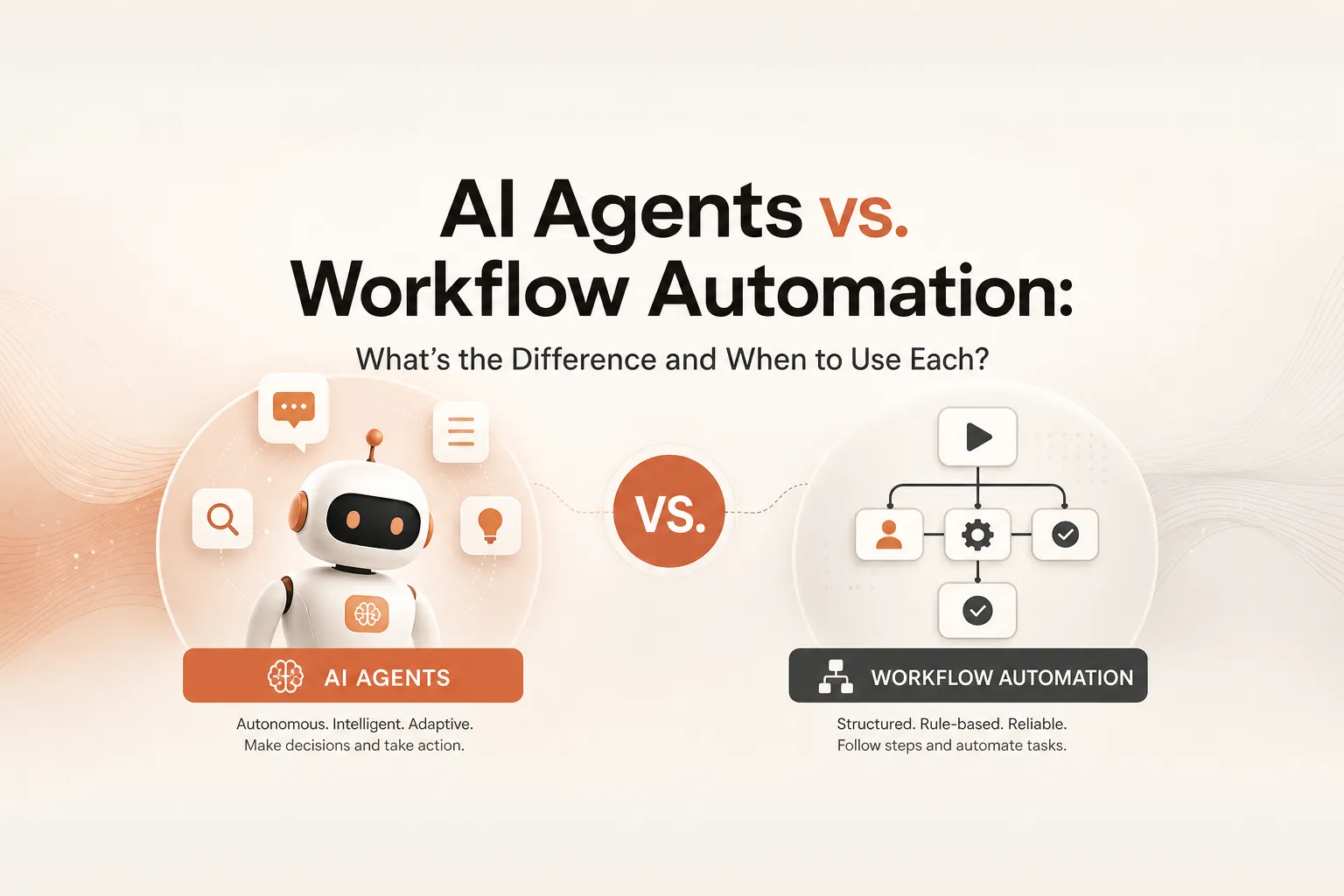
Every automation vendor now calls their product "AI-powered," which makes the actual question harder to answer: do you need an AI agent, or do you need a workflow? Gartner expects 40% of enterprise applications to ship with a task-specific AI agent by the end of 2026, up from under 5% in 2025 — but it also predicts 40% of agentic AI projects will be canceled by 2027 because teams pointed an agent at a problem a plain workflow already solved. Picking wrong is expensive in both directions.
What Is the Real Difference Between an AI Agent and Workflow Automation?
Workflow automation tools like n8n, Zapier, and Make execute a fixed sequence of steps — trigger, action, trigger, action — the same way every time. An AI agent is given a goal, a set of tools, and context, then decides for itself which tool to call, in what order, and stops when it judges the task complete. Workflow automation is deterministic. Agents are probabilistic: the same input can produce a different sequence of steps on two separate runs.
That single distinction — fixed script versus runtime decision-making — explains almost every other difference between the two. It's why one is cheap and predictable and the other is flexible and occasionally wrong in interesting ways.
| Dimension | Workflow Automation (n8n, Zapier, Make) | AI Agent |
|---|---|---|
| Execution logic | Fixed sequence, written in advance | Reasons about next step at runtime |
| Predictability | Same input → same output, every time | Same input can produce different paths |
| Handles unstructured input | Poorly — needs clean, structured data | Well — reads messy text, PDFs, emails |
| Debuggability | Fails at a specific, visible node | Failure requires reconstructing model reasoning |
| Cost per run | Fractions of a cent (API/task-based) | Cents to dollars (LLM tokens, multi-step) |
| Best fit | High-volume, rule-based, repeatable tasks | Judgment calls, ambiguous or novel inputs |
Key Takeaway: Workflow automation runs a script. An AI agent makes a decision. That's the whole difference — everything else (cost, predictability, debuggability) follows from it.
How Does Workflow Automation Like n8n and Zapier Actually Work?
Workflow automation is a rules engine that routes data between applications through triggers and actions defined in advance by a human. n8n, Zapier, and Make all work the same way at the core: something happens (a form is submitted, a row is added, a webhook fires), and a predetermined chain of steps executes in response — every single time, in the same order.
There's no reasoning involved. A "workflow" node checks a condition and branches left or right based on a value you specified. It doesn't interpret intent or handle a case you didn't anticipate — it either matches a rule or it doesn't.
This is precisely why workflow tools are reliable at scale. n8n has grown to a $1 billion valuation and over 180,000 GitHub stars by 2026 on the strength of that reliability — teams trust it to run the same integration correctly a million times, not to improvise. If your process is "when a Stripe payment succeeds, add the contact to HubSpot and send a Slack notification," you don't want a model reasoning about whether to do that. You want it to happen, identically, every time.
Key Takeaway: Workflow automation tools are rules engines, not decision-makers. Their value is doing the same correct thing every time — which makes them the right default for any process where consistency matters more than adaptability.
What Makes an AI Agent Different From an Automated Workflow?
An AI agent receives a goal and a set of tools, then plans its own sequence of actions to reach that goal — observing results and adjusting as it goes, rather than following a script written in advance. Unlike a workflow node, an agent's number of steps isn't fixed; it depends on what the agent encounters while running.
Take invoice processing as the standard example. A rules-based workflow parses invoices in one known format perfectly — and breaks or misfires the moment a vendor switches templates. An AI agent reads each invoice regardless of format, decides which fields matter, and adjusts its extraction approach instead of failing outright.
That flexibility is the entire value proposition of an agent. It's also the entire risk. A developer on the n8n community forum built the same invoice-classification workflow two ways — once with an AI Agent node calling Gemini across seven tools, once with a deterministic extractor node — and published the results. The deterministic version failed loudly and predictably at a specific step. The agent version produced different routing decisions across identical runs, and its self-reported confidence scores weren't reliable enough to catch its own mistakes. His conclusion: "agentic makes sense when you actually need reasoning — ambiguous decisions, multi-step planning, or work that genuinely can't be expressed as a graph." Invoice classification, in his case, wasn't one of those problems.
That's the trap teams fall into. An agent doesn't automatically outperform a workflow — it trades predictability for adaptability, and that trade only pays off when the task genuinely requires judgment.
Key Takeaway: An AI agent's strength — deciding its own path — is also its main liability. Use one when the task requires real judgment on unstructured input. Don't use one just because it's available.
When Should You Use Workflow Automation Instead of an AI Agent?
Use workflow automation for any process that is high-volume, rule-based, and doesn't change often — especially anywhere absolute consistency matters more than flexibility. If you can draw the process as a flowchart with no "it depends" branches, a workflow tool is faster, cheaper, and more reliable than an agent.
Good fits for n8n, Zapier, or Make:
- Syncing data between two systems (CRM ↔ spreadsheet ↔ Slack)
- Routing form submissions or webhook events to the right destination
- Scheduled reports pulled from known, structured data sources
- Compliance-critical steps that must run identically every time — no exceptions, no "reasoning its way through it"
- Any process a non-technical team member could fully document in a checklist today
That last point is the real test. If you can write the exact steps down and nothing in the process requires interpreting ambiguous input, an agent adds cost and unpredictability without adding value.
Key Takeaway: If the process can be fully specified in advance — no judgment calls, no ambiguous inputs — a plain workflow beats an agent on cost, speed, and reliability every time.
When Should You Use an AI Agent Instead of a Plain Workflow?
Use an AI agent when the task involves judgment, ambiguity, or unstructured input that a fixed set of rules can't cleanly cover — researching a prospect, triaging an inbound support ticket, drafting a personalized reply, or deciding what a messy document actually says. Agents earn their cost when the alternative is a human doing that judgment call manually.
Good fits for an AI agent:
- Reading unstructured input — emails, PDFs, chat transcripts — where the format varies every time
- Personalizing outreach based on research that changes per prospect
- Triaging and classifying inbound requests where the categories overlap or the signal is ambiguous
- Multi-step research tasks where the next action depends on what the previous step found
- Any task where a human today has to "use their judgment," not just follow a checklist
The common thread: agents belong wherever a human is currently making a small decision, over and over, based on context that doesn't fit a lookup table.
Key Takeaway: Reach for an agent when the bottleneck is judgment, not throughput. If a human is deciding rather than executing, that's the step worth automating with reasoning — not rules.
How Do AI Agents and Workflow Automation Work Together in Practice?
The realistic architecture in 2026 isn't "workflow or agent" — it's both, in the same pipeline. Deterministic workflow steps handle the trigger, data movement, and delivery; an AI agent is inserted only at the one step that genuinely requires reasoning. n8n's own AI Agent node is built around exactly this pattern, and it's how most production automation actually looks today.
A typical hybrid pipeline:
- Trigger (deterministic) — new lead hits the CRM, ticket comes in, invoice is uploaded
- Data prep (deterministic) — pull the record, normalize the format, attach context
- Judgment step (agent) — the one point where reasoning is genuinely required: classify intent, draft a personalized response, decide a routing exception
- Delivery (deterministic) — send the email, update the CRM field, post to Slack, file the record
The rule of thumb: keep everything deterministic that can be deterministic, and drop an agent in only for the step a human would otherwise have to think about. This is the same logic behind the orchestrator pattern used in multi-agent sales and marketing systems — specialized reasoning where it's needed, fixed logic everywhere else.
For teams building this in-house, Agentyug's agent development work is almost always this hybrid pattern in practice — not a fully autonomous agent replacing a whole process, but a workflow with one or two agent-powered decision points doing the part a human used to do manually. For everything upstream and downstream of that decision point, a business automation build on n8n or a comparable tool is the right, boring, reliable foundation.
Key Takeaway: Don't choose between agents and workflows — combine them. Deterministic steps for trigger, data, and delivery; an agent for the one step that requires actual judgment. That's the architecture nearly every production system converges on.
What Do AI Agents and Workflow Automation Cost to Run and Maintain?
Workflow automation costs fractions of a cent per execution — you're paying for API calls and task credits, not model reasoning. AI agents cost more per run because every step involves LLM tokens, and a multi-step agent task can burn tokens across several tool calls before it finishes. At volume, using an agent where a workflow would do isn't just riskier — it's meaningfully more expensive.
The cost gap compounds with volume. A workflow processing 10,000 structured records a month runs at a near-fixed, predictable cost. An AI agent processing the same volume — with variable step counts per run — has a cost that swings with how much reasoning each individual input actually required. That's manageable for a judgment-heavy task with real value per decision. It's wasteful for a task a rules engine could have handled for a fraction of the price.
This is also where Gartner's 40%-cancellation prediction comes from: agentic AI projects get killed when the cost and unpredictability of an agent turn out not to be justified by the task. The fix isn't avoiding agents — it's scoping them to the step where reasoning actually pays for itself, per the hybrid pattern above.
If you're weighing this trade-off for your own stack, book a consultation and we'll map which of your processes are workflow-shaped and which actually need an agent.
Key Takeaway: Cost isn't a reason to avoid agents — it's a reason to scope them narrowly. Run the numbers on cost-per-decision before deciding whether a step needs an agent or just a rule.
Frequently Asked Questions
Is n8n an AI agent platform or a workflow automation tool?
Both. n8n is a workflow automation platform at its core, but it includes a native AI Agent node that lets you drop LLM-based reasoning into an otherwise deterministic pipeline. Most production n8n workflows use the AI Agent node for one or two judgment-heavy steps while keeping the rest of the pipeline rule-based.
Can Zapier build true AI agents?
Zapier's Agents product lets you configure an AI-driven agent that reasons across a goal and a set of connected apps, similar in spirit to n8n's AI Agent node. It's best suited to the same narrow use case: judgment-based steps inside a broader automated process, not a fully autonomous system operating without any deterministic structure around it.
Is RPA the same thing as workflow automation?
No. Workflow automation (n8n, Zapier, Make) routes data between applications through APIs. RPA (robotic process automation) drives an application's screen directly, clicking and typing the way a human would — used specifically when no API exists to connect through. Both are deterministic; neither reasons the way an AI agent does.
Do AI agents replace the need for workflow automation tools?
No — if anything, they depend on them. Even fully agent-driven systems need deterministic infrastructure for triggers, data handling, and delivery around the agent's decision point. The realistic pattern is an agent embedded inside a workflow, not an agent replacing the workflow entirely.
How do I decide whether my first automation project should be a workflow or an agent?
Write the process down as a checklist. If every step can be specified in advance with no "it depends," build it as a workflow — it'll be faster, cheaper, and more reliable. If one step requires reading unstructured input or making a judgment call a human currently makes manually, that single step is a candidate for an agent; everything else around it should stay deterministic.
Will AI agents eventually replace tools like n8n and Zapier entirely?
Unlikely in the near term. n8n's AI Agent node and Zapier's Agents product show both companies building agents into their workflow platforms rather than positioning agents as a replacement. The deterministic infrastructure — triggers, data movement, delivery — still needs to exist around any agent's decision point, regardless of how capable the agent itself becomes.
Sources
- Gartner Predicts 40% of Enterprise Apps Will Feature Task-Specific AI Agents by 2026, Up From Less Than 5% in 2025, Gartner
- Agentic AI vs. RPA: Everything You Need to Know, Zapier
- Agentic vs. Deterministic: I Built the Same n8n Workflow Both Ways. The Agent Lost., n8n Community
- We Need to Re-Learn What AI Agent Development Tools Are in 2026, n8n Blog
- RPA vs Agentic AI: Key Differences & Enterprise Solutions, CloudEagle