
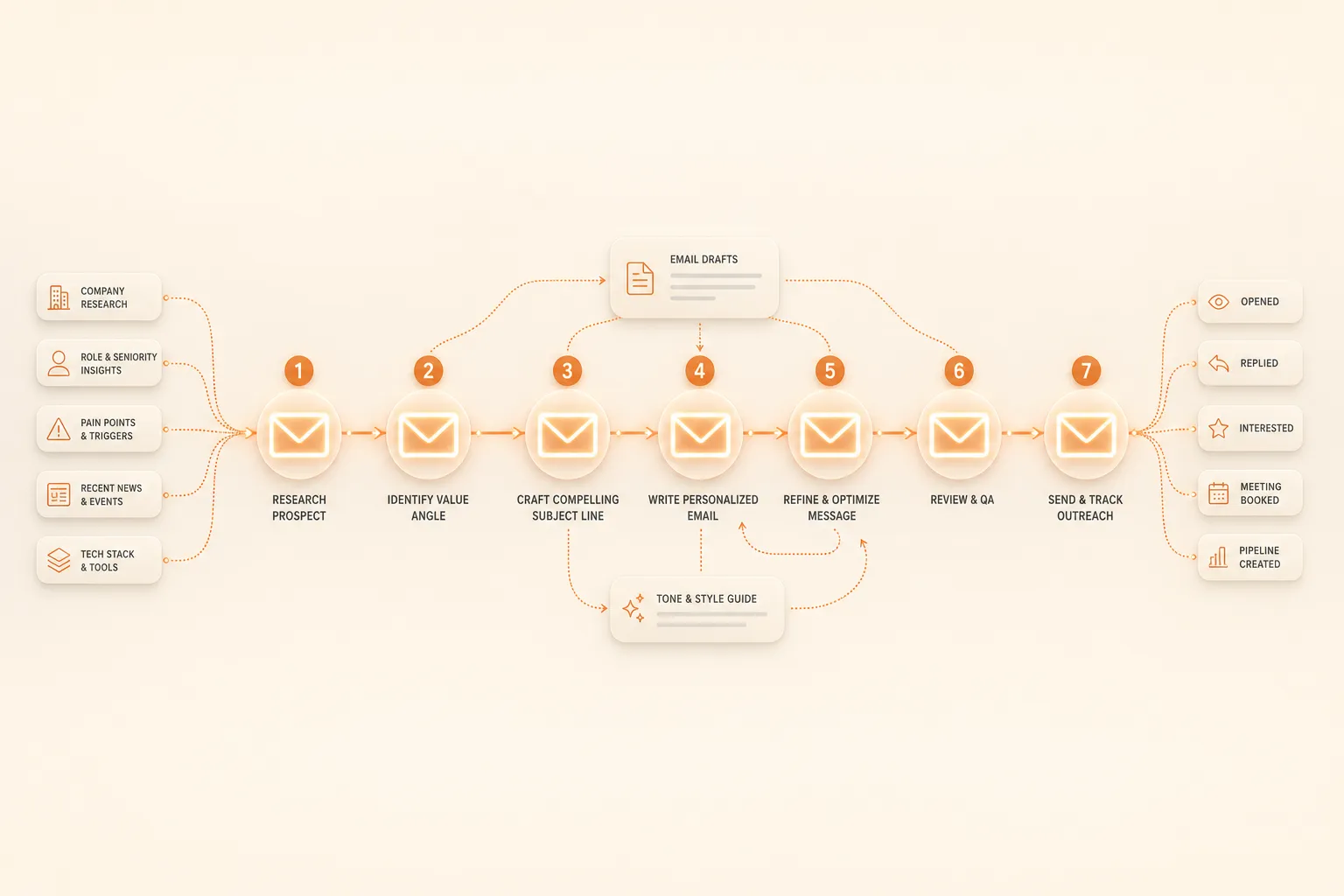
Most cold email advice is written by people who haven't sent a cold email in three years. They recycle the same "personalize your subject line" tips while ignoring the infrastructure changes that made those tactics obsolete. Lavender analyzed 4.2 million cold emails in 2024. The data is blunt: emails under 75 words get 2x the replies of emails over 150 words. Single CTA emails convert 42% better than emails with multiple asks. And yet most sales teams are still sending 300-word wall-of-text templates that were mediocre in 2021. Here are the seven scripts that are actually booking meetings in 2026 — with the exact templates, the mechanics behind each, and the infrastructure you need to make them land.
What Makes a Cold Email Script Actually Work in 2026?
A cold email script works in 2026 when it passes three tests: it demonstrates specific research the prospect can verify, it fits in a mobile preview (under 75 words), and it asks for one thing. Every word that doesn't advance the reply is costing you response rate. The February 2024 Google and Yahoo sender policy changes raised the floor — bad emails now actively damage your domain reputation, not just your reply rate.
The stats make the case clear:
- Emails under 75 words: 2x reply rate vs. emails over 150 words (Lavender, 4.2M emails analyzed)
- Personalized subject lines: +26% open rate lift (Campaign Monitor)
- Single CTA vs. multiple: 42% higher conversion (Lavender 2024)
- 68% of B2B buyers prefer email over phone for first contact (Salesforce State of Sales 2024)
- Top-performing sequences: 5–7 touchpoints over 14 days, not one blast
Since February 2024, Google and Yahoo require SPF, DKIM, and DMARC authentication for bulk senders. Spam rate above 0.10% triggers deliverability consequences. Unsubscribes must be honored within 2 days. Volume without quality is now self-destructive — every email you send either builds or damages your domain's sending reputation.
Key Takeaway: The 2026 cold email environment rewards short, specific, single-ask emails and penalizes volume without quality. Google and Yahoo now enforce authentication and spam rate thresholds that make deliverability a prerequisite — not an afterthought.
What Are the 7 Cold Email Scripts That Generate Replies in 2026?
The seven highest-performing cold email scripts in 2026 are: the Trigger Event, the Mutual Connection, the Pain Point (PAS), the Case Study, the Compliment + Ask, the Competitor Switch, and the 3-Line Pattern Interrupt. Each works for a different targeting scenario — pick based on the signal you have on the prospect, not personal preference.
Script 1: The Trigger Event Email
Use within 72 hours of a funding announcement, major hire, or job posting that signals budget or a known pain point. Recency creates relevance — the prospect is already thinking about the problem you solve.
Subject: Congrats on the [Series B] — quick thought

Hi [First Name],

Saw [Company] just closed [funding amount] — congrats.

A lot of teams at your stage start running into [specific bottleneck] right around now.

We helped [Similar Company] solve that in [timeframe], adding [specific result].

Worth a 15-minute call this week?

[Name]
The fill-in that matters: the specific bottleneck must match their stage and your service. "Scaling outbound without hiring five SDRs" is specific. "Growing faster" is useless.
Script 2: The Mutual Connection Email
Use when you share a verified LinkedIn connection, alumni network, or community. Trust transfers immediately — the prospect's guard drops when a name they recognize appears in the opening line.
Subject: [Mutual Name] suggested I reach out

Hi [First Name],

[Mutual Name] mentioned you're the right person to talk to about [specific challenge].

We recently helped [Mutual's company or peer company] [specific result] — and [Mutual Name] thought the approach might be relevant for [Company].

Do you have 15 minutes this week?

[Name]
Only use this with genuine endorsement. Using it as a fabricated frame is a trust-killer — and in a niche B2B market, it will be discovered.
Script 3: The Pain Point (PAS) Email
Problem → Agitate → Solution. The most reliable frame for cold outreach when you have strong ICP data. Loss aversion drives response: "here's what's costing you" outperforms "here's what you could gain."
Subject: [Company]'s [process] — a quick question

Hi [First Name],

Most [job title]s at [company stage] tell us [specific pain — e.g., "reps spend 40% of time on data entry instead of selling"].

Left unchecked, that usually means [consequence — e.g., "quota attainment drops and attrition spikes"].

We built [service] specifically to fix that. [Client] went from [before] to [after] in [timeframe].

Open to a quick conversation?

[Name]
The agitation line — the consequence sentence — is what most people skip. Don't. That's where the emotional leverage lives.
Script 4: The Case Study Email
Lead with proof. When you have a named case study from a company in the same vertical, size, or role, it's the most persuasive cold email format. "They did it for someone exactly like me" removes risk.
Subject: How [Client Company] got [result] in [timeframe]

Hi [First Name],

We recently helped [Client Company] — [one-line similarity to prospect] — [specific result, e.g., "cut their sales cycle from 45 to 22 days"].

Given [Company] is also [relevant similarity], I thought the approach might be worth a look.

I can send the two-minute overview, or walk you through it on a call.

Which works better?

[Name]
"Which works better?" is a soft binary that reduces friction. Compare to "let me know if you're interested" — which transfers all cognitive load to the prospect.
Script 5: The Compliment + Ask Email
Use when the prospect has published content, spoken at a conference, or written a LinkedIn post you can genuinely connect to your offer. The compliment must be specific enough it could only apply to them.
Subject: Your [podcast/post/talk] on [topic] — a follow-up thought

Hi [First Name],

Your [content type] on [topic] — specifically the point about [exact idea] — was genuinely useful.

It made me think: [Company] is probably dealing with [logical implication].

That's exactly what we helped [Similar Company] with. [One-sentence result].

Worth 20 minutes to compare notes?

[Name]
What fails: "Great content!" What works: "Your point about async selling reducing SDR burnout — we actually tested that and found the opposite. Would love to share what we found." Specific, disagreeable, curiosity-inducing.
Script 6: The Competitor Switch Email
Use when you have a signal the prospect may be unhappy with a competitor — a G2 review, a LinkedIn post, a job posting that mentions "replacing [tool]," or intent data from Bombora. High-risk if mistimed; high-reward when the timing is right.
Subject: Switching from [Competitor]?

Hi [First Name],

Noticed [Company] has been using [Competitor] — and based on [specific signal], it looks like you might be hitting some walls with [specific limitation].

We built [service] specifically for teams that have outgrown [Competitor's weakness].

[Client Name] made the switch 6 months ago and [specific result].

Worth 15 minutes?

[Name]
The signal you cite is the credibility anchor. "Based on a G2 review your team posted" is research. "I assumed you use them" is a guess. One earns attention; the other earns the delete key.
Script 7: The 3-Line Pattern Interrupt
Use as a first touch for VP-and-above prospects, or as a breakup email after a longer sequence hasn't worked. Extreme brevity is itself the pattern interrupt — most cold emails are 200–300 words. Three lines reads as confident and respectful of their time.
Subject: Your SDRs are probably wasting 2 hours a day

Hi [First Name],

Most VP Sales we talk to don't realize 40% of rep time goes to tasks that don't move deals forward.

We fixed that for [Company]'s SDR team — they added 22 meetings booked per month without hiring.

15 minutes this week?

[Name]
Every line must do work. If a line doesn't advance the reply, delete it. This script fails the moment you add "I hope this finds you well" or a two-sentence company intro. Resist entirely.
Key Takeaway: The script you use should match the signal you have — not your comfort zone. Trigger Event and Mutual Connection emails have the highest reply rates when executed with genuine data. The 3-Line Pattern Interrupt is the highest-leverage format for senior buyers when you have a strong proof point.
How Do You Set Up Cold Email Infrastructure That Doesn't Land in Spam?
Cold email infrastructure in 2026 requires three non-negotiables before sending a single email: SPF, DKIM, and DMARC authentication on your sending domain; a minimum 4-week domain warmup; and a dedicated sending domain separate from your primary business domain. Skip any one of these and your emails will be rejected or spam-foldered before the subject line is read.
Step-by-step setup:
- Create a dedicated sending domain — never use yourcompany.com. Use getyourcompany.com or tryyourcompany.com. Protect your primary domain's reputation from any campaign risk.
- Configure SPF, DKIM, and DMARC — SPF specifies which servers can send on your behalf. DKIM adds a cryptographic signature. DMARC defines what happens with unauthenticated mail. Verify all three at mxtoolbox.com before warming.
- Warm the domain — Week 1: 10–20 emails/day. Week 2: 50–100/day. Week 3: 200–500/day. Week 4+: scale to target. Instantly.ai and Smartlead both have built-in warmup networks.
- Verify your list — bounce rates above 3–5% damage sender reputation fast. Use ZeroBounce or NeverBounce to clean every list before it touches your sending domain.
- Monitor spam rate in Google Postmaster Tools — Google's threshold is 0.10%. Above 0.30% sustained means deliverability consequences.
This infrastructure layer is what separates teams running AI-powered lead generation at 90%+ open rates from teams wondering why campaigns land in spam. The scripts are irrelevant if the domain is burnt.
Key Takeaway: A great cold email script on a burnt domain is still spam. Set up authentication, warm a dedicated sending domain for 4 weeks, verify the list, and monitor your spam rate in Google Postmaster Tools — before you write a single word of copy.
What Mistakes Are Killing Your Cold Email Reply Rate?
The fastest reply rate killers in 2026 are: starting with "I," vague CTAs, emails over 150 words, sending from your primary domain, skipping DMARC setup, buying unverified lists, using HTML templates with images, and including multiple links in a first touch. Each reduces reply rate or deliverability independently. Combined, they make your campaign invisible.
The fastest fixes — each one costs nothing and typically moves reply rate within two weeks:
- Stop opening with "I" — "I help companies like yours" is the most common opener in cold email and the clearest signal it's a template. Start with the prospect: "Your recent post on..." or "Noticed [Company] just..."
- Replace vague CTAs with specific binary asks — "Let me know if interested" puts the decision on the prospect with no anchor. "Do you have 15 minutes Tuesday or Wednesday?" is specific, low-commitment, and easy to answer yes or no.
- Switch to plain text — Spam filters flag image-heavy HTML. Plain text emails read like emails from a real person, because they are.
- One link maximum — Multiple links in a first touch trigger spam classification. If you include a calendar link, that's your one link. No attachments on first touch.
- Build the follow-up sequence — Most replies come from touches 2 through 4. A single email with no follow-up leaves 60–70% of potential replies on the table. The sequence ends when you get a reply or reach the breakup email — not before.
This is exactly why companies are replacing SDR teams with GTM engineers who know how to build and operate systematic outbound — the mistakes above aren't talent failures, they're systems failures.
Key Takeaway: Four free changes typically double reply rates: shorten the email, change the opener to start with the prospect, replace the vague CTA with a specific binary ask, and switch from HTML to plain text. Do those four things before spending a dollar on tools.
What Tools Do Top Cold Email Teams Use in 2026?
The standard cold email stack in 2026 runs on five categories: enrichment and prospecting (Clay, Apollo), sending infrastructure (Instantly.ai, Smartlead), email writing assistance (Lavender AI), list verification (ZeroBounce), and deliverability monitoring (Google Postmaster Tools). Teams that skip enrichment send generic emails. Teams that skip deliverability monitoring burn domains without knowing it.
| Tool | Role | Key Capability |
|---|---|---|
| Clay | Enrichment + personalization | 50+ data sources; AI-written first lines per contact |
| Apollo.io | Prospecting + sequences | 275M+ contact database with built-in sending |
| Instantly.ai | Sending infrastructure | Unlimited accounts, inbox rotation, built-in warmup |
| Smartlead | Multi-channel sequences | Smart inbox rotation, master inbox, email + LinkedIn |
| Lavender AI | Email writing assistant | Real-time reply likelihood scoring, personalization tips |
| ZeroBounce | List verification | Removes invalid addresses before they damage reputation |
| Google Postmaster Tools | Deliverability monitoring | Tracks spam rate and domain reputation in real time |
For a full comparison of how these tools fit into a broader GTM stack, the top GTM automation tools comparison for 2026 covers how Clay, Apollo, Instantly, and Smartlead layer with Claude Code and AI agent workflows.
For teams who want the entire outbound system built and running — ICP identification, Clay enrichment, personalization at scale, Instantly setup, and CRM sync — Agentyug's lead generation service handles the full build. Or book a consultation to map your specific setup before committing to a build.
Key Takeaway: The cold email stack covers five non-skippable functions: verified data, authentication and warmup, reply likelihood scoring, sending infrastructure, and deliverability monitoring. One gap and you're either sending to invalid addresses or burning domains silently. Close all five before scaling volume.
Frequently Asked Questions
What is the best cold email script for B2B sales in 2026?
The best cold email script matches the signal you have on the prospect. If they just raised funding, use the Trigger Event script. If you share a mutual connection, use the Referral frame. For senior executives with no specific signal, the 3-Line Pattern Interrupt consistently outperforms longer formats. There is no single best script — there is only the right script for the data you have.
How long should a cold email be in 2026?
Lavender's analysis of 4.2 million cold emails found emails under 75 words get 2x the reply rate of emails over 150 words. The optimal length is 50–75 words for a cold first touch. Every sentence that doesn't advance the reply reduces your response rate.
What subject line gets the highest cold email open rate?
Personalized subject lines tied to a specific trigger — funding, hiring signal, content they published — consistently outperform generic lines. The "Congrats on the [event] — quick thought" format and the "[Mutual Name] suggested I reach out" format have the highest open rates. Subject lines of 6–10 words and under 60 characters prevent mobile truncation, where 60%+ of emails are first opened.
Does cold email still work in 2026?
Yes — but the definition has shifted. Volume-without-quality campaigns are now self-destructive because spam complaints damage domain reputation and trigger deliverability consequences. The teams with 8–15% reply rates in 2026 are sending fewer emails, to tighter ICPs, with higher personalization. Cold email works; cold spam doesn't.
What is the Google and Yahoo sender policy change?
In February 2024, Google and Yahoo enforced mandatory SPF, DKIM, and DMARC authentication for bulk senders sending 5,000+ emails per day. Emails failing authentication are rejected or spam-foldered. Senders must also support one-click unsubscribe and maintain spam rates below 0.10%. These requirements are the new baseline for any cold email operation that wants reliable inbox placement.
How many follow-up emails should a cold sequence include?
Research consistently shows the majority of replies come from touches 2 through 4. A 5–7 step sequence over 14 days is the current best practice. Each follow-up should add a new angle, not just say "just following up." End with a short breakup email that closes the loop — it occasionally generates a reply from a prospect who had been ignoring the thread.
Related Reading
- Why Are Companies Replacing SDR Teams With GTM Engineers? — The economics of running AI-powered outbound vs. a human SDR team
- How Do GTM Engineers Use Claude Code to Build Pipeline on Autopilot? — Automating the research and enrichment layer that makes cold email personalization scale
- What Are the Top GTM Automation Tools of 2026? — Full stack comparison: Clay, Apollo, Instantly, Smartlead, and more
About the Author
Akansh is the founder of Agentyug and has spent the last 5 years building AI automation systems for marketing agencies and B2B businesses. He's built 500+ workflows, automated lead generation pipelines that achieve 90%+ open rates, and helped teams reclaim 20–40 hours per week. Has built and managed cold email systems for B2B clients including multi-domain setups processing 1,000+ personalized emails per day. Connect on LinkedIn or view the author profile.
Sources
- Email Benchmark Report 2024, Lavender AI
- Email Marketing Statistics 2024, HubSpot
- Email Marketing Benchmarks by Industry, Mailchimp
- State of Sales Report, 6th Edition, Salesforce
- Gmail Email Sender Guidelines, Google
- Yahoo Sender Requirements, Yahoo
- Cold Email Statistics and Benchmarks, Cognism
- B2B Sales Benchmark Report, Belkins Agency