
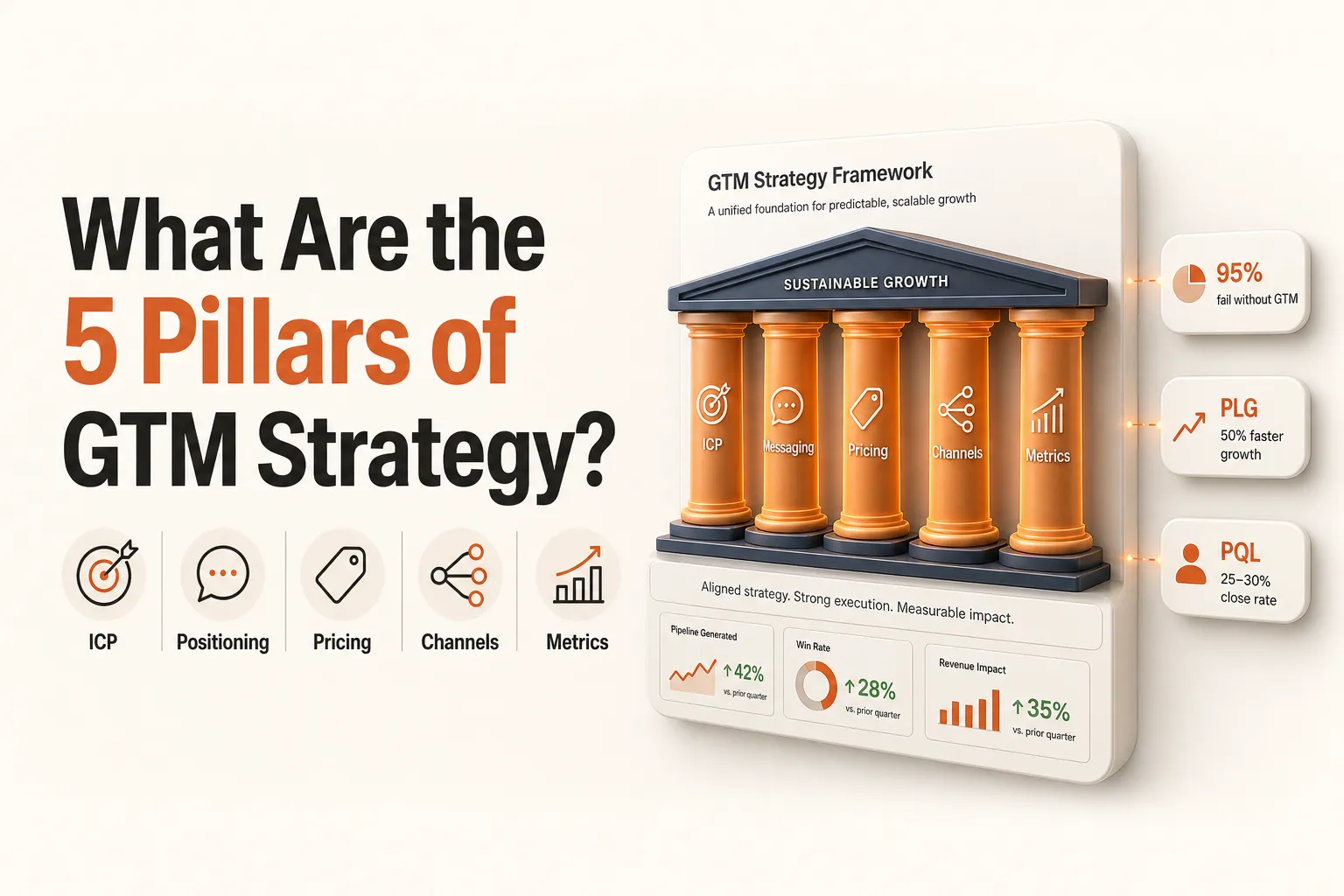
Ninety-five percent of new products fail. Not because the product is bad. Not because the market doesn't exist. Because there was no coherent plan for getting the product in front of the right people, at the right price, through the right channels.
That number comes from Go-to-Market Statistics 2026. Gartner found that only 55% of product launches ship on schedule. The average delay is four months. Four months of burned runway, frustrated sales teams, and a market that moved on without you.
A go-to-market strategy is not a launch checklist. It's the operating system for how a product reaches customers and generates revenue. Get the five pillars right and you have a system that compounds. Miss one and the whole thing leaks.
Here's the framework that actually works. With the data to back it up.
What Is a GTM Strategy, and Why Do Most Teams Get It Wrong?
A go-to-market (GTM) strategy is the plan a business uses to launch a product, enter a new market, or drive revenue from an existing product into a new segment. It is narrower than a business plan. It focuses on one question: how do you get from "we built this" to "customers are paying for it."
Most teams confuse GTM with marketing. They're not the same. Marketing is one component of GTM. GTM includes your target customer definition, your pricing model, your distribution channels, your sales motion, and the metrics that tell you whether any of it is working.
The difference between a company with a tight GTM and one without? According to Searchlab's GTM Statistics report, only 11% of companies prioritize effective hand-off and audience alignment across their GTM motion. The other 89% are executing in silos: marketing doing one thing, sales doing another, product building a third.
That's the gap. Five pillars close it.
Pillar 1: ICP and Market Segmentation (Who You Are Selling To)
Your Ideal Customer Profile (ICP) is the most important decision in your GTM. It determines who you target, what you say, what you charge, and which channels you use. Everything downstream depends on getting this right. Most teams define their ICP once and never revisit it. That's the mistake.
ICP is not a persona. A persona is a character. An ICP is a set of firmographic and behavioral criteria (industry, company size, revenue, tech stack, buying triggers) that define the accounts most likely to buy, stay, and expand.
According to Gartner's ICP framework, ICP-driven segmentation produces faster sales cycles, higher conversion rates, and greater lifetime value. Teams that segment by ICP don't just close deals faster. They also retain customers longer.
Here's a practical ICP framework that holds up:
- Firmographic: Company size, revenue, geography, industry
- Technographic: Tools they already use (CRM, automation stack, data providers)
- Behavioral: Buying triggers (headcount growth, funding rounds, tech migrations)
- Economic: Budget authority, deal size, payback timeline
The companies that skip ICP usually discover the problem at quarter end. They have 50 customers, five different use cases, and no idea which one to build for next.
Bottom line: Your ICP is not a marketing exercise. It's the foundation every other pillar is built on.
Pillar 2: Positioning and Messaging (Slack's 8,000 Users in 24 Hours)
Positioning is how your product fits in the market relative to alternatives. Messaging is how you communicate that fit. Get both right and the market pulls you in. Get either wrong and you're pushing uphill, spending more on sales and marketing to achieve the same result.
Slack launched in 2013 into a market where email dominated and Skype owned video. They didn't pitch "better team communication." They pitched the elimination of a pain: buried email threads, lost context, miscommunication tax. The result? 8,000 sign-ups in the first 24 hours. A $1 billion valuation in 1.25 years, the fastest path to unicorn status at the time.
That wasn't luck. That was positioning executed correctly.
Dropbox did something similar with three words: "Your files, everywhere." Not "cloud storage." Not "file synchronization." The problem they were solving was access. Your files on your laptop are not on your phone. Simple insight. Clear message. Viral mechanics baked into the product (refer a friend, get storage).
Notion built their GTM around a consolidation play. The market had Docs. It had Sheets. It had Trello. Notion said: stop managing six tools. Do it all in one place. Then they activated community-driven growth through Notion Ambassadors in Japan, LATAM, and design communities, and let word-of-mouth carry the message regionally.
The test for your messaging: can someone who heard your pitch once explain it correctly to a peer? If not, it's not clear enough.
What separates winning messages from noise:
- Instead of "saves time": "reduces lead qualification from 2 hours to 15 minutes"
- Instead of "powerful automation": "eliminates the 5.5 hours per week reps spend on bad data"
- Instead of "all-in-one platform": "one workspace that replaces Docs, Sheets, and your task manager"
Bottom line: Specificity in messaging isn't a style preference. It's the mechanism that makes people remember you and repeat what you said.
Pillar 3: Pricing and Packaging (The Pillar Most Frameworks Ignore)
Pricing is not a finance decision. It's a GTM decision. Your price signals who the product is for, how much value you're claiming to create, and which motion (self-serve, sales-assisted, or enterprise) you are built for. Get the price wrong and you attract the wrong customers, burn through sales cycles that don't close, or leave millions on the table.
Most GTM frameworks barely touch pricing. That's a mistake. Pricing is the single variable that most directly affects every other pillar.
Here's how it works in practice:
- Under $5,000 ACV (Annual Contract Value): Product-led growth (PLG) wins. Self-serve, trial-first, no-touch motion. Sales involvement is too expensive to justify.
- $5,000 to $10,000 ACV: Hybrid. Product does the education, sales closes and expands.
- Above $10,000 ACV: Sales-led. Enterprise buying committees, longer cycles, relationship-driven.
This isn't theory. Research from Amplemarket and ProductLed's benchmark report consistently show PLG dominates sub-$5k ACV and sales-led wins above $10k.
Pricing packaging matters too. SaaS companies that offer a freemium or free trial convert at different rates depending on structure:
- Free trial products: 17% of signups convert to paid
- Freemium products: 5% of signups convert to paid
- Product Qualified Leads (PQLs): 25 to 30% convert vs. 5 to 10% for MQLs
Loom understood this. Their view-before-signup model let recipients watch a Loom without creating an account. The video did the selling. The friction was in recording, not watching. That inverted freemium logic drove viral adoption with essentially zero marketing cost.
Bottom line: Price at the right level for your motion. Freemium works when the product sells itself. Sales-led works when the value requires explanation.
Pillar 4: Channels and Route to Market (PLG vs. Sales-Led vs. Hybrid)
Your channel strategy answers one question: how does your product physically reach its buyers? The answer determines your team structure, your cost structure, and your growth ceiling. Choosing the wrong motion (PLG when you need sales, sales when you need product) is the single fastest way to burn cash without building pipeline.
There are three primary GTM motions:
Product-Led Growth (PLG)
The product is the main acquisition and conversion mechanism. Users try before they buy. Virality, in-product prompts, and usage-based triggers drive conversion.
PLG companies achieve 50% higher revenue growth rates than traditional sales-led counterparts while spending 39% less on sales and marketing, according to PLG benchmark data. Net Revenue Retention runs 15 to 20% higher in PLG companies.
Best for: products with ACV below $5,000, viral use cases, fast time-to-value.
Sales-Led Growth (SLG)
Outbound prospecting, inbound qualification, and human-assisted sales carry the motion. SDRs, AEs, and solution engineers drive revenue.
This is the motion you need above $10k ACV. Almost no enterprise contract above $100,000 closes without meaningful human involvement. 67% of B2B buyers now prefer a rep-free, self-service buying experience, but they still want a human for the close.
A well-built outbound motion using tools like Apollo, Clay, and Smartlead can process 5,000 enriched leads per month and run multi-channel sequences for under $500 total. That's the modern GTM stack in action.
Hybrid (Product-Led Sales)
The product handles early-stage education and activation. Sales steps in at the point of upgrade, expansion, or enterprise intent. This is the dominant motion in 2026, and research shows hybrid models report 2x higher profitability compared to pure PLG or pure SLG approaches.
Hybrid works like this: free users hit a usage wall, generate a PQL signal (trigger in the product), and a sales rep engages with context: "I see you've invited 8 teammates and hit your storage limit." That context-aware outreach closes at 25 to 30% vs. 5 to 10% for cold MQLs.
Bottom line: Match your channel motion to your ACV. Below $5k, let the product do the work. Above $10k, sales is mandatory. In between, hybrid wins.
Pillar 5: Revenue Execution and Metrics (Where Plans Meet Reality)
This is where strategy meets proof. Revenue execution means building the processes, tooling, and team that translate pillar 1 through 4 into measurable pipeline and closed revenue. Metrics are how you know whether your ICP is right, your messaging is landing, your pricing is correct, and your channel is working. Without this pillar, you have a plan. With it, you have a system.
Most GTM teams track the wrong metrics. They watch MQL volume and email open rates. Those are activity metrics. What actually matters:
The metrics that tell you if your GTM is working:
| Metric | Benchmark |
|---|---|
| Pipeline coverage | 3 to 4x your revenue target |
| Lead to Qualified | 30 to 50% |
| Qualified to Opportunity | 40 to 60% |
| Opportunity to Close | 25 to 40% |
| Overall Lead to Close | 5 to 15% |
| LTV:CAC ratio | 3:1 or better |
| CAC payback period | Under 12 months |
| Free to Paid (trial) | 17% |
| Free to Paid (freemium) | 5% |
| PQL to Paid | 25 to 30% |
Source: Aventi Group GTM Metrics and PLG Statistics 2026
Revenue execution also means the right tools in the right order. You need a CRM that reps actually trust, which means clean data. Bad CRM data costs the average organization $12.9 million per year, according to Gartner. Sales reps spend 5.5 hours per week on data they don't trust. That's a full workday of zero pipeline.
The fix isn't telling reps to update records. It's automating the enrichment so the data stays accurate without anyone touching it. That's where tools like Clay, HubSpot Breeze Intelligence, and n8n become part of your GTM execution, not just back-office tools. For a full breakdown of the GTM automation tools that actually move the needle, see our comparison guide.
Bottom line: You can't optimize what you don't measure. Pick the five metrics that matter to your motion and review them weekly.
The Traditional 5-Pillar Framework vs. The Modern Version
Most GTM articles will give you these five pillars:
- Product Analysis
- Product Messaging
- Sales Proposition
- Marketing Strategy
- Sales Strategy
That framework isn't wrong. It's incomplete. Here's what's missing:
| Traditional Framework | Modern Framework |
|---|---|
| Product Analysis | ICP + Market Segmentation |
| Product Messaging | Positioning + Messaging |
| Sales Proposition | Pricing + Packaging |
| Marketing Strategy | Channels + Route to Market (PLG/SLG/Hybrid) |
| Sales Strategy | Revenue Execution + Metrics |
The traditional framework treats ICP as part of product analysis. It does not. Your ICP outlives your product roadmap. It treats pricing as part of the proposition, but pricing is a standalone motion decision with its own conversion implications. And it says nothing about PLG, hybrid models, or the metric frameworks that determine whether execution is working.
The modern framework is built for how SaaS actually goes to market in 2026, where 67% of buyers want self-service evaluation, where PQL conversion triples MQL conversion, and where the hybrid motion is statistically the most profitable.
Frequently Asked Questions
What exactly is a GTM strategy in simple terms?
A GTM (go-to-market) strategy is your plan for getting a product in front of the right customers and converting them into revenue. It defines who you're selling to, what you're saying, what you're charging, how you're reaching them, and how you know it's working. It's narrower than a business plan, focused on one product launch or market entry.
Can I skip one of the five GTM pillars?
Pillar 1 (ICP) and Pillar 2 (Positioning) are non-negotiable. Every other decision depends on them. Pillar 3 (Pricing) determines your entire motion. You cannot choose channels without it. You can simplify Pillars 4 and 5 early on, but you can't skip them. Teams that skip metrics tracking are flying blind. They cannot tell which pillar is broken when pipeline stalls.
What's the difference between PLG and sales-led GTM?
Product-led growth (PLG) uses the product itself as the main acquisition and conversion mechanism. Users self-serve, trial the product, and convert based on their experience. Sales-led growth uses human sales effort (outbound, inbound, demos) to close deals. PLG wins below $5,000 ACV; sales-led wins above $10,000. PLG companies grow 50% faster with 39% lower sales and marketing spend, but they require a product that sells itself.
How long does it take to build a full GTM strategy?
ICP and positioning: 2 to 4 weeks. Pricing and packaging: 1 to 2 weeks (with customer testing). Channel selection and motion design: 1 to 2 weeks. Execution setup (CRM, tools, sequences, metrics): 2 to 4 weeks. Total: 6 to 12 weeks for a first version. Expect to iterate quarterly. Your first GTM will be wrong in at least one pillar. That's normal. The metrics in Pillar 5 tell you where.
What GTM metrics should I track first?
Start with three: pipeline coverage (aim for 3 to 4x your revenue target), opportunity-to-close rate (benchmark: 25 to 40%), and CAC payback period (target: under 12 months). Once those are stable, layer in activation rate, PQL conversion, and NRR. Do not track everything at once. You will optimize for the wrong things if you do.
Do I need all 5 pillars for product-led growth?
Yes, but weighted differently. PLG teams invest most heavily in ICP (to know who to build for), messaging (to reduce friction in self-serve), and pricing (to nail the freemium-to-paid trigger). Channel selection becomes simpler (product is the channel), and metrics focus shifts to activation rate, time-to-value, and PQL conversion rather than sales pipeline coverage.